
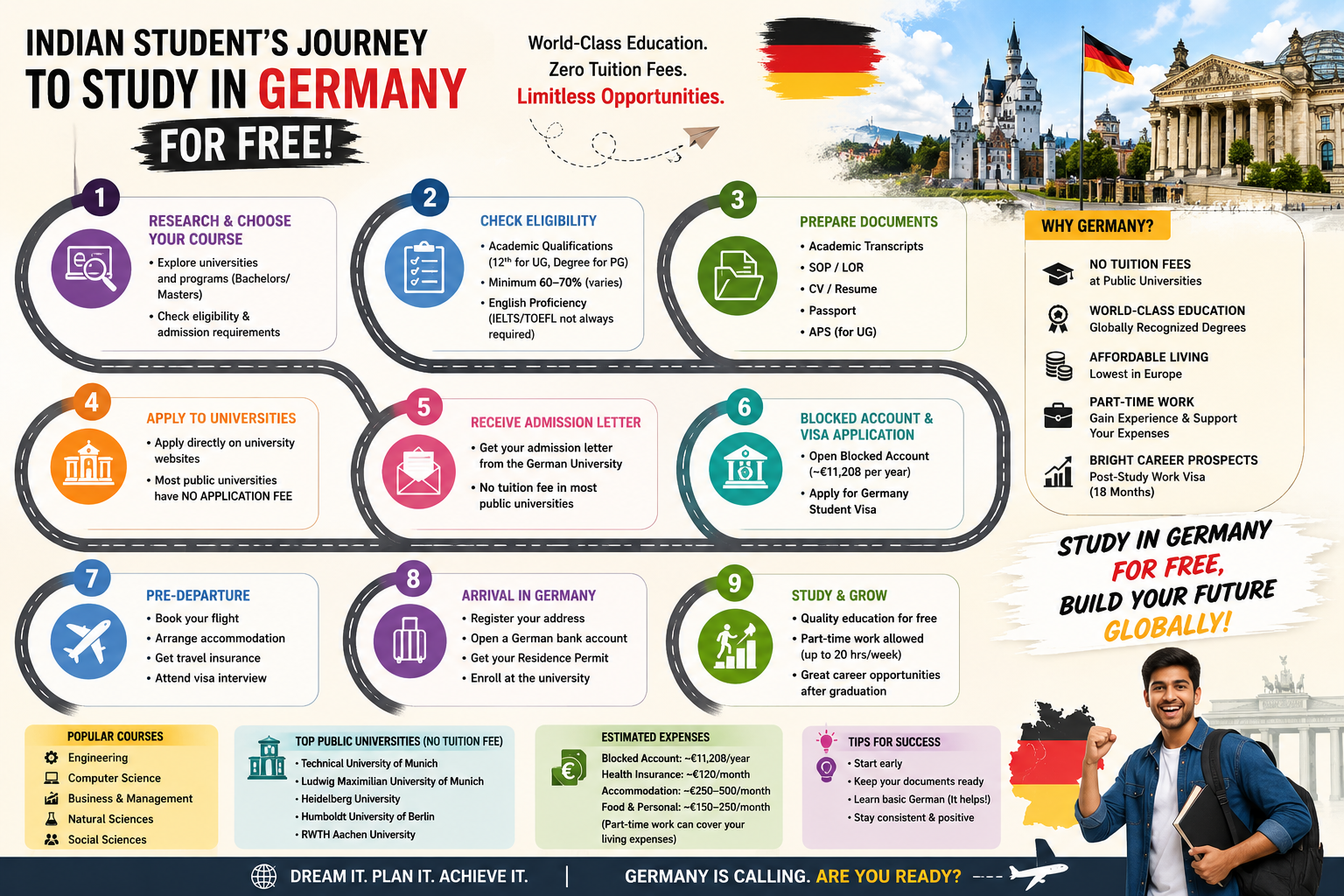
Germany continues to attract international students because of its strong public-university system, diverse study programmes and comparatively affordable higher-education options.
For Indian and other international students, however, studying in Germany requires careful academic and financial planning. Low or no tuition at a particular university does not mean that studying and living in Germany has no cost.
Here is what students should consider when exploring Germany as a study destination in 2026.
Is Higher Education in Germany Tuition-Free?
Many public universities in Germany do not charge general tuition fees for a first degree and for many Master’s programmes.
However, this should not be understood as a universal rule.
Tuition policies can differ by federal state, institution and programme. For example, non-EU students at many institutions in Baden-Württemberg generally face tuition fees, while individual universities elsewhere may also have their own fee arrangements.
Students should therefore confirm the current tuition policy directly with every university and programme they are considering.
Even where tuition fees do not apply, students normally pay a semester contribution.
This contribution supports services such as student administration and student organisations, and at some institutions may include or contribute toward public-transport benefits.
Planning Your Study and Living Budget
Tuition is only one part of the total cost of studying abroad.
Students should also plan for expenses such as:
- Accommodation
- Food and daily living
- Health insurance
- Local transportation
- Semester contributions
- Study materials
- Personal expenses
Living expenses can vary significantly depending on the city and lifestyle.
Larger cities such as Munich, Frankfurt and Berlin can have different accommodation costs from smaller university cities.
Before selecting a university, students should compare both the academic programme and the overall cost of living in that location.
Choosing the Right German University
Choosing a university should involve more than comparing rankings.
Students should review:
Programme Suitability
Compare the curriculum, modules, academic focus and learning outcomes with your long-term academic and career goals.
University Type
Germany has different types of higher-education institutions, including research-oriented universities and universities of applied sciences.
The right choice depends on whether your goals are primarily academic, research-oriented or professionally focused.
Location
Consider accommodation availability, living costs, transportation and access to relevant industries.
Programme Costs
Check the university’s current tuition policy, semester contribution and any programme-specific charges directly before making a decision.
Can International Students Work While Studying?
International students may have opportunities to work alongside their studies, subject to applicable rules.
Under current German rules, many students from non-EU countries can generally work up to 140 full days or 280 half-days per year, with an alternative framework allowing certain students to work up to 20 hours per week during study periods. Students should always check the latest applicable rules through official German sources because conditions can change. Make it in Germany
Part-time work can provide useful professional experience, but students should not choose a study destination solely on the expectation of earning enough to cover all study and living costs.
Academic commitments should remain the priority.
English-Taught vs. German-Taught Programmes
Germany offers programmes taught in both German and English.
German-language proficiency can significantly increase the number of programmes available to a student, particularly at undergraduate level.
English-taught programmes are also available, especially at postgraduate level, but availability varies considerably between universities and subject areas.
Students should check the official programme page for:
- Teaching language
- Academic eligibility
- Language expectations
- Programme duration
- Curriculum
- Tuition and semester costs
- Application timeline
Learning German can also be valuable for everyday life, internships and future career development.
How to Plan Your Germany Study Application
Instead of following a single generic application checklist, students should work from the current information published by each university.
Step 1: Research Suitable Programmes
Use reliable university and academic databases to compare programmes relevant to your educational background and career goals.
The DAAD database is a useful starting point for researching German higher-education options.
Step 2: Compare Academic Criteria
Universities and programmes may have different academic expectations.
Review the current programme criteria directly on the university’s official website.
Step 3: Check Language Expectations
Confirm whether your selected programme is taught in German, English or a combination of both.
Check the level of language proficiency expected by the institution.
Step 4: Compare Costs
Review:
- Tuition policy
- Semester contribution
- Estimated living costs
- Accommodation costs
- Other programme-related expenses
Do this before committing to a university.
Step 5: Check the University’s Current Timeline
Application periods are not identical across every German university or programme.
Some institutions use commonly seen semester deadlines, while others have programme-specific or applicant-specific dates.
Students should therefore rely on the current deadline published by the university they intend to apply to rather than assuming that one deadline applies everywhere.
Scholarships and Funding Opportunities
Students can also research scholarships and other funding opportunities.
The German Academic Exchange Service, commonly known as DAAD, provides information about a range of scholarship programmes.
Funding may also be available through:
- Universities
- Academic foundations
- Research organisations
- Programme-specific scholarship schemes
- Other recognised funding organisations
Scholarship availability, eligibility criteria and award amounts vary, so students should check the latest information directly with the organisation offering the scholarship.
Career Considerations
Germany offers opportunities across a wide range of industries, particularly in areas such as engineering, technology, manufacturing, research, healthcare and business.
However, career outcomes depend on many factors, including:
- Academic qualification
- Relevant skills
- German-language ability
- Professional experience
- Industry demand
- Individual circumstances
No university programme or study destination can guarantee employment.
Students should consider career possibilities as one factor when selecting a programme rather than treating future employment as an assured outcome.
Study Planning Checklist
Before choosing Germany, consider:
- Researching suitable universities and programmes
- Comparing public and private institutions
- Checking current tuition and semester costs
- Reviewing academic eligibility
- Checking the programme’s teaching language
- Comparing different university locations
- Estimating accommodation and living expenses
- Exploring available scholarships
- Reviewing programme-specific application timelines
- Verifying important information directly with the selected university
The Bottom Line
Germany can offer attractive higher-education opportunities for international students, particularly through its public-university system.
However, students should not assume that every programme is completely free.
Tuition policies, semester contributions, programme criteria, living expenses and other costs vary between institutions and locations.
The best approach is to compare universities carefully, understand the full cost of studying and living abroad and make decisions using current information published by the relevant educational institution.
Planning to Study in Germany?
Wizdom International provides independent education counselling for students exploring Germany and other international study destinations.
Our guidance may include:
- University and programme comparison
- Course shortlisting
- Academic planning
- Study-destination information
- Language-test preparation
- General study-planning guidance
Speak with a counsellor to discuss your academic goals and study options.
Important Note
Wizdom International is an independent private consultancy and is not affiliated with any German university or government authority.
Admission and other decisions made by universities and independent third parties remain outside the control of Wizdom International.