
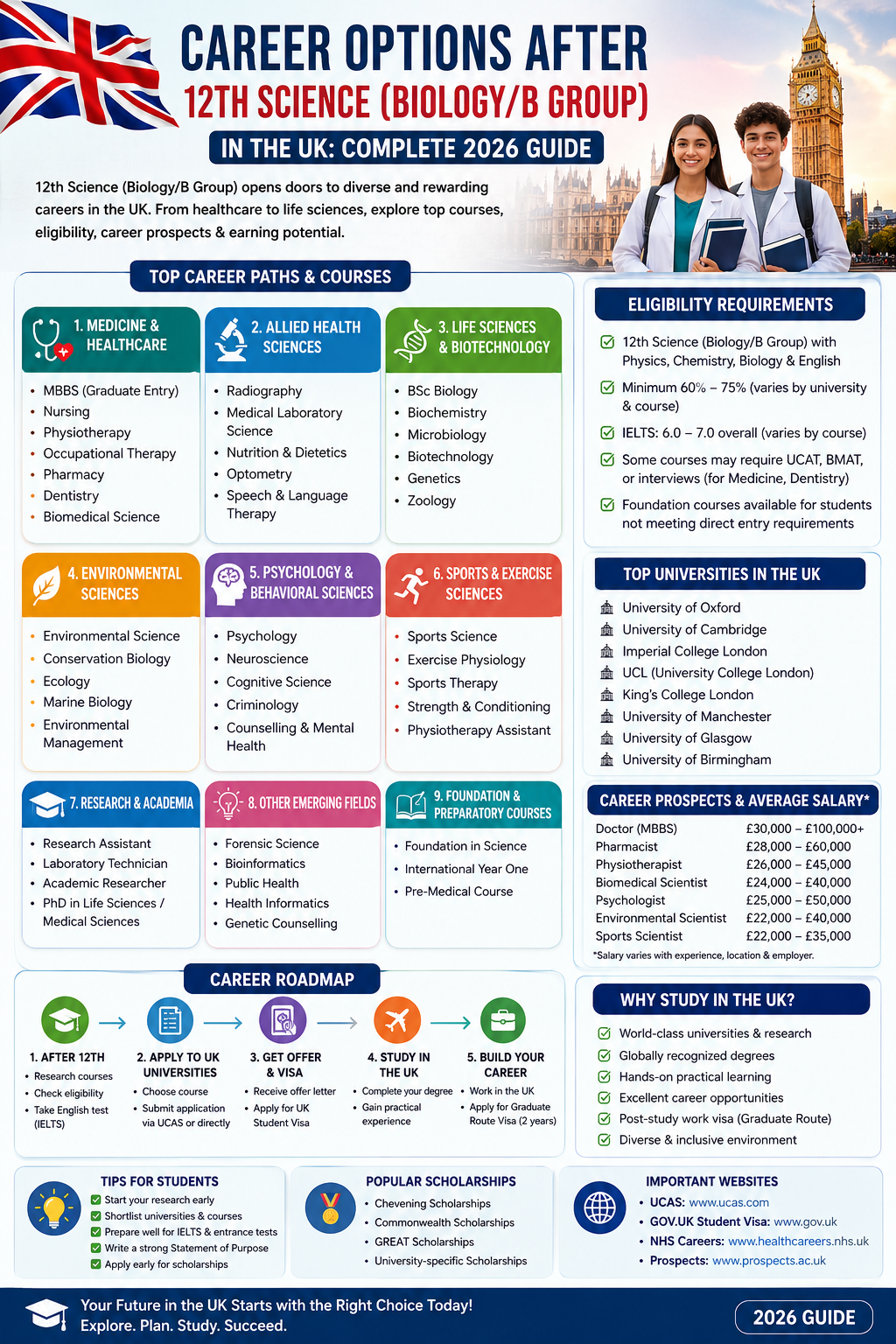
Students completing Class 12 Science with Biology have a wide range of university options beyond traditional medical pathways.
The UK offers undergraduate programmes across biomedical science, biotechnology, biological sciences, biochemistry, pharmacology, microbiology, neuroscience, environmental science and related fields.
For Indian students considering the UK, the right course should be selected based on academic interests, subject background, university entry criteria, programme content, tuition costs and long-term career goals.
This guide explains the main study options, academic considerations, university choices, costs and application-planning points for students exploring UK bioscience programmes.
Why Consider the UK for Biology Studies?
UK universities offer a broad range of programmes in biological and life sciences.
Students may benefit from:
- A wide selection of specialised bioscience degrees
- Strong research environments
- Laboratory-based learning
- Opportunities for industry placements on selected programmes
- Undergraduate degrees that are commonly three years in England, Wales and Northern Ireland
- Opportunities to continue into postgraduate study or research
- Exposure to internationally recognised academic institutions
Programme structure, duration and opportunities vary by university, so students should compare individual courses carefully before applying.
Popular Courses After 12th Biology
1. Biomedical Science
Biomedical Science focuses on human biology, disease processes, diagnostics and laboratory science.
Typical areas of study may include physiology, pathology, biochemistry, genetics, immunology, microbiology and pharmacology.
Students interested in professional biomedical-science careers should check whether a particular programme has relevant professional accreditation and whether additional training or registration requirements apply.
2. Biotechnology
Biotechnology combines biological science with technology and applied research.
Students may study molecular biology, genetics, microbial biotechnology, cell biology, bioprocessing and related areas.
Potential career areas include biotechnology, pharmaceuticals, laboratory research, food science and environmental applications.
3. Biological Sciences
Biological Sciences provides broad study across multiple areas of life science.
Typical topics can include genetics, evolution, ecology, cell biology, animal behaviour and molecular biology.
Some programmes allow students to specialise during later stages of the degree.
4. Biochemistry
Biochemistry explores chemical processes within living organisms.
Students may progress into laboratory research, biotechnology, pharmaceuticals, healthcare-related research or further academic study.
5. Molecular Biology and Genetics
This field focuses on genes, molecular processes and heredity.
Study areas may include molecular genetics, human genetics, microbial genetics, biotechnology and cell biology.
6. Pharmacology
Pharmacology examines how medicines and other substances interact with biological systems.
Students may study drug action, physiology, toxicology, drug development and clinical-research principles.
7. Microbiology
Microbiology focuses on microorganisms including bacteria, viruses and fungi.
Career areas may include healthcare laboratories, biotechnology, food science, environmental science and research.
8. Zoology
Zoology covers animal biology, physiology, behaviour and ecology.
Possible career areas include conservation, environmental organisations, wildlife management and research.
9. Environmental Biology
Environmental Biology explores interactions between living organisms and the environment.
Typical areas include ecology, biodiversity, conservation and environmental change.
10. Neuroscience
Neuroscience studies the structure and function of the nervous system.
It combines areas of biology, psychology, chemistry and medicine and may lead to research or further specialised study.
11. Biomedical Engineering
Biomedical Engineering combines aspects of biological science, healthcare and engineering.
Students should check course-specific entry criteria carefully because some programmes require strong preparation in mathematics or physics.
12. Medicine
Indian students may also explore undergraduate Medicine programmes in the UK.
Medicine is highly competitive, and individual medical schools set their own academic criteria, admissions assessments and selection processes.
Students considering Medicine should rely on the current requirements published directly by each medical school.
UK Universities to Explore for Biology-Related Courses
Students may research bioscience programmes at institutions such as:
- University of Cambridge
- University of Oxford
- Imperial College London
- University of Edinburgh
- University of Manchester
- University of Birmingham
- University of Nottingham
- University of Sheffield
- University of Surrey
- University of Bristol
- University of Leicester
- Queen Mary University of London
- University of Glasgow
This list is provided for general research purposes and does not indicate that Wizdom International is affiliated with these institutions.
Programme availability and entry criteria should always be verified directly with the relevant university.
Entry Criteria for Indian Students
There is no single Class 12 percentage requirement that applies to every UK university or bioscience programme.
Entry criteria may depend on:
- The university
- The selected programme
- The student’s examination board
- Required Class 12 subjects
- Course competitiveness
- English-language expectations
Students should therefore avoid relying on generic statements such as “80% guarantees admission.”
The correct approach is to check the current entry criteria published by each university for the exact programme being considered.
Academic Background
Biology-related programmes may expect previous study in subjects such as Biology, Chemistry, Mathematics or Physics.
The required subject combination differs by course.
For example, Biomedical Engineering may require stronger mathematics or physics preparation than a general Biological Sciences programme.
English-Language Criteria
UK universities generally expect international applicants to demonstrate suitable English-language ability.
Accepted qualifications and minimum scores vary between institutions.
Depending on the university, accepted evidence may include recognised English-language tests, previous education completed in English or other institution-approved alternatives.
Students should check the current English-language policy of their selected university rather than assuming that one rule applies across the UK.
Foundation Programmes
Students who do not meet direct undergraduate entry criteria may be able to consider a foundation programme.
A foundation course may help students develop academic knowledge, English-language ability and university-study skills.
Progression to a bachelor’s programme is usually subject to meeting the academic and other conditions specified by the provider.
A foundation programme should therefore not be treated as an automatic or guaranteed route to a degree unless the institution expressly states such an arrangement.
Tuition Fees and Study Costs
International tuition fees vary considerably across UK universities and bioscience programmes.
Laboratory-intensive or highly specialised programmes may have different fee levels from other undergraduate degrees.
When comparing universities, students should consider:
- Annual tuition fees
- Programme duration
- Course-specific costs
- Accommodation
- Food and daily expenses
- Local transportation
- Study materials
- Personal expenses
Fees can change between academic years, so students should check the current fee information published by each university before making a financial decision.
Planning Your Living Costs
Living expenses depend heavily on location and lifestyle.
London and some major university cities can be more expensive than smaller locations.
Students should prepare a realistic budget covering accommodation, food, transportation, personal expenses, study materials, mobile and internet costs and other day-to-day spending.
No single UK living-cost figure can accurately predict what every student will spend.
Career Options After a Biology Degree
A biology or bioscience degree can support many different academic and professional pathways.
Potential directions include biomedical science, clinical research, biotechnology, pharmaceuticals, laboratory research, scientific communication, environmental science, conservation and further academic study.
Professional roles may sometimes require additional training, accreditation or registration.
Biomedical Science and Healthcare
Possible areas may include biomedical laboratories, clinical research, diagnostic science, healthcare research and related scientific roles.
Pharmaceuticals and Biotechnology
Potential career areas include drug development, laboratory research, biotechnology, quality assurance, regulatory affairs and clinical research.
Research and Academia
Students interested in academic research may progress into Master’s study, doctoral research, laboratory work or research-support roles.
Scientific Communication
Biology graduates may also explore medical writing, scientific communication, publishing and research communication.
Environmental and Conservation Careers
Potential areas include ecology, conservation, environmental consulting, wildlife research and sustainability-related work.
Education
With appropriate qualifications and further training where required, graduates may explore teaching, academic support or other education-related roles.
Career and Salary Considerations
Salary outcomes vary substantially depending on role, employer, location, experience, qualification level, professional requirements and industry conditions.
Students should avoid selecting a course primarily because of an advertised salary figure.
Published salary data may be useful for general research, but it should not be interpreted as a guaranteed earning outcome.
Completing a particular degree does not guarantee employment or a specific salary.
Placement and Sandwich Courses
Some UK universities offer courses that include an optional or integrated industry placement.
A placement may help students gain practical workplace experience, understand professional environments and explore potential career directions.
Placement availability, selection criteria, payment arrangements and employer participation vary between programmes.
A placement year should not be described as guaranteeing future employment.
Application Planning
Students applying for undergraduate study in the UK generally use UCAS.
Important dates can vary by academic year and programme type.
Students considering Oxford, Cambridge, Medicine, Dentistry or Veterinary programmes should be particularly careful because these courses commonly have earlier deadlines than many other undergraduate programmes.
Applicants should always confirm the current deadline for their chosen course through UCAS and the university’s official website before submitting an application.
Scholarships and Funding
Many UK universities offer scholarships or other financial support for international students.
Potential categories may include:
- Merit-based scholarships
- Subject-specific awards
- International-student scholarships
- Country-specific opportunities
- University-specific funding
Availability, eligibility and award value vary by institution and year.
Students should check the official scholarship page of each university for current information.
Common Mistakes to Avoid
1. Assuming Every University Has the Same Entry Criteria
Requirements vary between universities and programmes.
Check each programme individually.
2. Choosing a Course Only Because of Its Name
Two programmes with similar names may have very different curricula.
Compare modules, teaching methods and learning outcomes.
3. Ignoring Professional Accreditation
Students interested in regulated professions should check whether professional accreditation or registration may be relevant to their intended career.
4. Assuming a Foundation Programme Guarantees Progression
Progression may depend on academic performance and other programme conditions.
5. Relying on Outdated Tuition Fees
Use current fee information published by the university.
6. Choosing a Course Based on Salary Claims
Career and earning outcomes depend on many factors and cannot be guaranteed.
7. Missing Course-Specific Deadlines
Some programmes use earlier application deadlines than others.
Always check current information for your chosen course.
Frequently Asked Questions
Can I study in the UK after Class 12 Science with Biology?
Yes.
UK universities offer many undergraduate programmes suitable for students with a Biology background.
Options may include Biomedical Science, Biotechnology, Biological Sciences, Biochemistry, Pharmacology, Microbiology, Neuroscience and related subjects.
Entry requirements vary by university and programme.
Can I study in the UK without IELTS?
Possibly, depending on the university.
Some institutions may accept alternative evidence of English-language proficiency.
The policy differs between universities, so students should check the current criteria published by their chosen institution.
What percentage is required after Class 12 Biology?
There is no single percentage that applies across UK universities.
Requirements depend on the university, programme, examination board and required subjects.
Students should check the current published criteria for each course.
How much does a UK bioscience degree cost?
International tuition fees vary significantly by institution and programme.
Students should check current tuition fees, programme duration and estimated living costs before making a financial decision.
Which course is best after 12th Biology?
There is no single best course for every student.
The right choice depends on interests, academic strengths and long-term goals.
Biomedical Science may suit students interested in human health and laboratory science.
Biotechnology may suit students interested in applied biology and innovation.
Biological Sciences may suit students who want a broad scientific foundation.
Environmental Biology may suit students interested in ecology and conservation.
Pharmacology may suit students interested in medicines and drug development.
Can I study Medicine after Class 12 Biology?
Yes, Indian students may explore UK Medicine programmes where they meet the applicable academic and selection criteria.
Medicine is highly competitive, and each medical school sets its own requirements.
Students should verify current information directly with the relevant university.
Are jobs guaranteed after a UK biology degree?
No.
A university degree does not guarantee employment.
Career outcomes depend on qualifications, skills, experience, professional requirements, industry conditions and individual circumstances.
Final Thoughts
A Class 12 Biology background can lead to many different academic pathways in the UK.
The most important question is not simply whether you should study in the UK, but which course and university best match your interests, academic preparation and future goals.
Before selecting a programme, compare course content, academic criteria, subject requirements, tuition and living costs, professional accreditation where relevant, placement opportunities and current application timelines.
Students should verify important information directly with the relevant university before making an application or financial decision.
Planning Your UK Biology Study Journey?
Wizdom International provides independent international-education counselling for students exploring undergraduate study options in the UK and other destinations.
Our guidance may include university and course comparison, academic profile discussion, programme shortlisting, study planning, application-timeline guidance, English-language test preparation and general education counselling.
Speak with our counsellors to discuss your academic goals and explore suitable study options.
Important Note
Wizdom International is an independent private consultancy and is not affiliated with UK universities or UK government authorities.
University admission decisions and other third-party decisions remain outside the control of Wizdom International.
Students should verify current academic criteria, tuition fees, deadlines and programme information directly with the relevant university before making an application or financial decision.