
How to Study for Free in Germany: The Complete 2026 Guide for International Students
Germany has become one of the world’s top destinations for international students, offering tuition-free or near-free education at over 400 public universities. For Indian students and other international applicants, this presents a life-changing opportunity to earn a world-class degree without the crushing burden of tuition debt. But here is the truth that many aspirants overlook: tuition-free does not mean cost-free. Let us break down exactly how you can study in Germany for free in 2026 and what it really takes to make it happen.
Is Germany Really Tuition-Free in 2026?
The short answer is yes, but with important nuances.
In 14 of Germany’s 16 federal states, public universities charge no tuition fees for international students, including those from outside the EU. This applies to both Bachelor’s and Master’s programmes. German public universities charge no tuition fees for most undergraduate and many graduate programmes.
The one major exception is the state of Baden-Württemberg, which charges non-EU students approximately 1,500 euros per semester. If you want truly free education, target universities outside this state, which still leaves you with hundreds of excellent options across the country.
Instead of tuition, you will pay a semester contribution, known as Semesterbeitrag, of 150 to 350 euros per semester. This covers administrative fees, student services, and typically includes a public transport pass that lets you travel across the entire state for free, a significant saving in itself.
The Hidden Cost: The Blocked Account
Here is where most students get surprised. To obtain a German student visa, you must prove you have sufficient financial resources to cover your living expenses for one year. As of August 2026, the required amount is 11,904 euros, which works out to 992 euros per month.
This money must be deposited into a blocked account, called a Sperrkonto, a special German bank account that releases only 992 euros to you each month. The account is locked until you arrive in Germany, and the funds cannot be withdrawn as a lump sum.
For Indian students, this translates to approximately 11.9 lakh rupees that must be deposited and frozen before your visa is approved. This is not a fee; it is your living expense money for the year. You will receive it back in monthly installments to pay for accommodation, food, health insurance, and other necessities.
The key takeaway is that you need 11,904 euros upfront before you can even apply for the visa.
How Much Does Living in Germany Actually Cost?
While tuition is free, living costs vary significantly by city. Here is a realistic monthly breakdown:
Accommodation costs range from 300 to 600 euros. Food and groceries run between 150 and 250 euros. Health insurance is mandatory and costs roughly 110 to 130 euros per month. The semester contribution is around 300 euros per semester. Transportation is generally included in the semester fee. Study materials add another 20 to 50 euros. This brings the total monthly expenditure to approximately 850 to 1,100 euros.
Students in smaller cities like Jena, Leipzig, or Dortmund will spend less than those in Munich, Frankfurt, or Berlin. Choose your university city wisely to stretch your blocked account further.
Can You Work While Studying?
Yes, and this is how many students supplement their living expenses.
International students on a German student visa can work 140 full days, meaning shifts longer than 4 hours, or 280 half-days of 4 hours or fewer, per year. During semester breaks, you can work more freely.
The German government expects that through part-time work, you can earn at least the monthly requirement of 992 euros. Popular student jobs include working in cafes, restaurants, or retail; tutoring, especially English or your native language; research assistant positions at your university; and internships related to your field of study.
It is important to note that your work must not interfere with your studies, and you must maintain your student status.
English-Taught vs. German-Taught Programmes
Here is a critical distinction: most free programmes require fluency in German. If you want to study in English, the options are more limited, though they do exist.
For German-taught programmes, you typically need B2 or C1 level German proficiency. You have access to thousands of tuition-free programmes and you will integrate better into German society and improve job prospects.
For English-taught programmes, many are at private universities which charge tuition. Public universities do offer some English-taught Master’s programmes, but competition is higher for English-language spots.
Practical advice: if you are serious about studying in Germany for free, start learning German now. Even if you enrol in an English programme, daily life, part-time jobs, and social integration require German language skills.
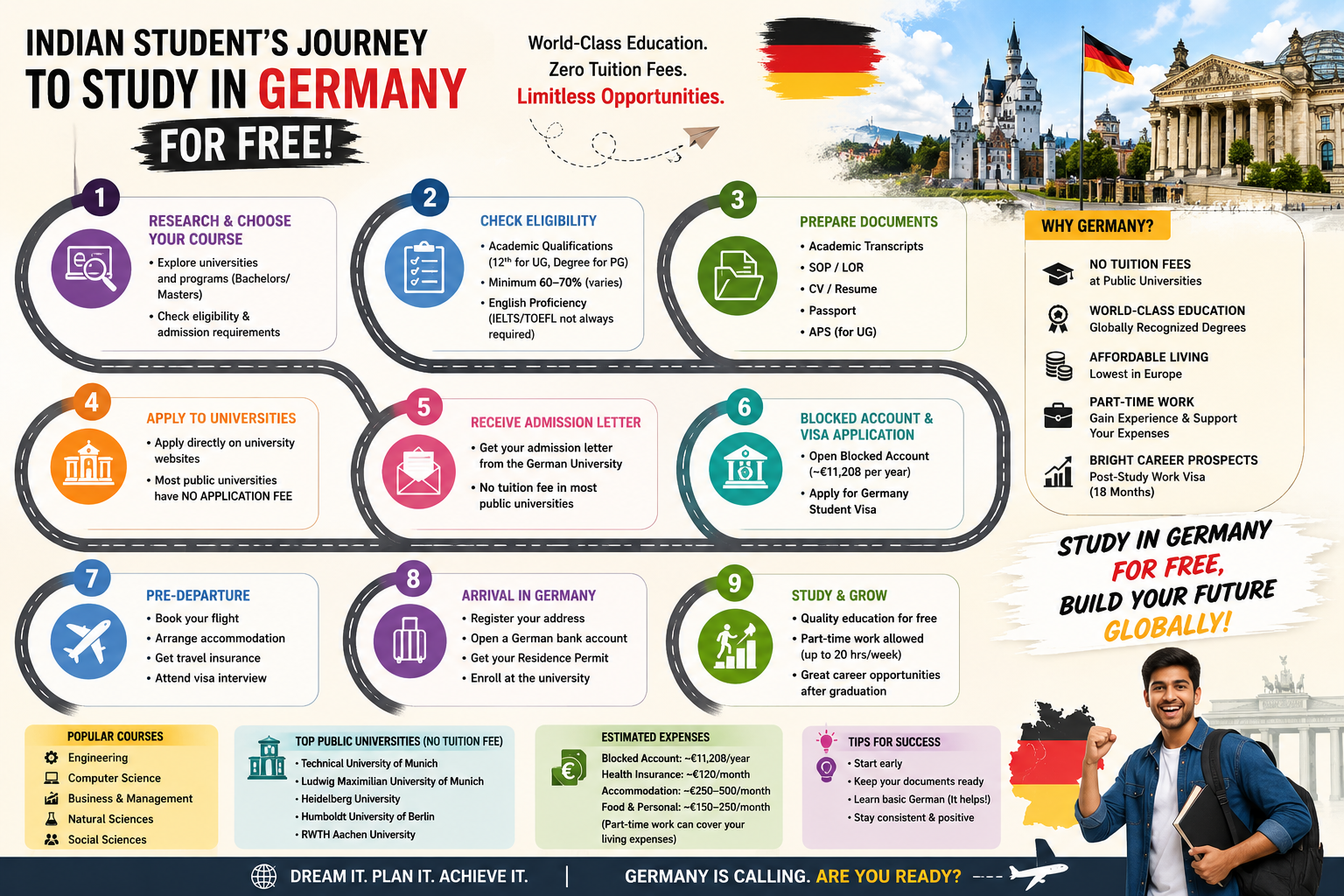
How to Apply: Step-by-Step Guide
Step 1: Research and shortlist universities. Use the DAAD, or German Academic Exchange Service, database to find tuition-free programmes that match your profile. Filter by state and remember to avoid Baden-Württemberg if you want to stay completely tuition-free.
Step 2: Check admission requirements. Each university has specific requirements. Most require academic transcripts, language proficiency proof in German or English, a statement of purpose, and letters of recommendation for Master’s programmes.
Step 3: Apply directly to universities. Unlike many countries, Germany does not have a centralised application system for all universities. Apply directly through each university’s portal. Deadlines are typically July 15 for the winter semester and January 15 for the summer semester.
Step 4: Get your APS certificate for Indian students. Indian students must obtain an APS, or Akademische Prüfstelle, certificate before applying for a visa. This process can take 6 to 12 weeks, so factor this into your timeline.
Step 5: Open your blocked account. Once you receive an admission letter, open a blocked account with a recognised provider and deposit 11,904 euros.
Step 6: Apply for your student visa. Book your visa appointment early, as waiting times at German consulates can be 3 to 6 months. Processing takes 4 to 12 weeks after your appointment. The visa fee is approximately 75 euros.
Pro tip: apply at least 6 to 8 months before your intended start date. The peak season from May to August sees the longest delays.
Scholarships and Additional Funding
While tuition is free, scholarships can help cover living costs. The DAAD offers various scholarships for international students. Other options include the Deutschlandstipendium, or Germany Scholarship, which provides 300 euros per month, university-specific scholarships, and government scholarships from your home country.
Remember that even with a scholarship, you may still need to show some funds in a blocked account.
The Post-Study Opportunity
Here is what makes Germany truly attractive: after graduation, international students can stay for 18 months on a job-seeker visa to find work. Germany’s strong economy and shortage of skilled workers mean that graduates with German language skills have excellent career prospects.
Since 2024, India-Germany dual citizenship is now permitted, opening pathways for long-term settlement.
Final Checklist for 2026 Applicants
Research tuition-free universities outside Baden-Württemberg.
Start learning German with a target of B2 level.
Prepare your academic documents.
Apply to universities by July 15 for the winter semester.
Get your APS certificate, allowing 6 to 12 weeks.
Open a blocked account with 11,904 euros.
Book your visa appointment 3 to 6 months early.
Apply for health insurance.
Submit your visa application with the 75 euro fee.
Wait 4 to 12 weeks for processing.
The Bottom Line
Studying in Germany for free is absolutely possible in 2026, but it requires planning, upfront capital, and language preparation. The tuition may be zero, but the blocked account of 11,904 euros is non-negotiable. Start your preparations at least one year in advance, learn German, and apply early.
Wizdom International helps students navigate every step of this journey, from university selection and application assistance to visa guidance and blocked account setup. Germany’s tuition-free education is waiting. The question is: are you ready to take the first step?
For personalized guidance on studying in Germany, contact Wizdom International today for a free consultation.