
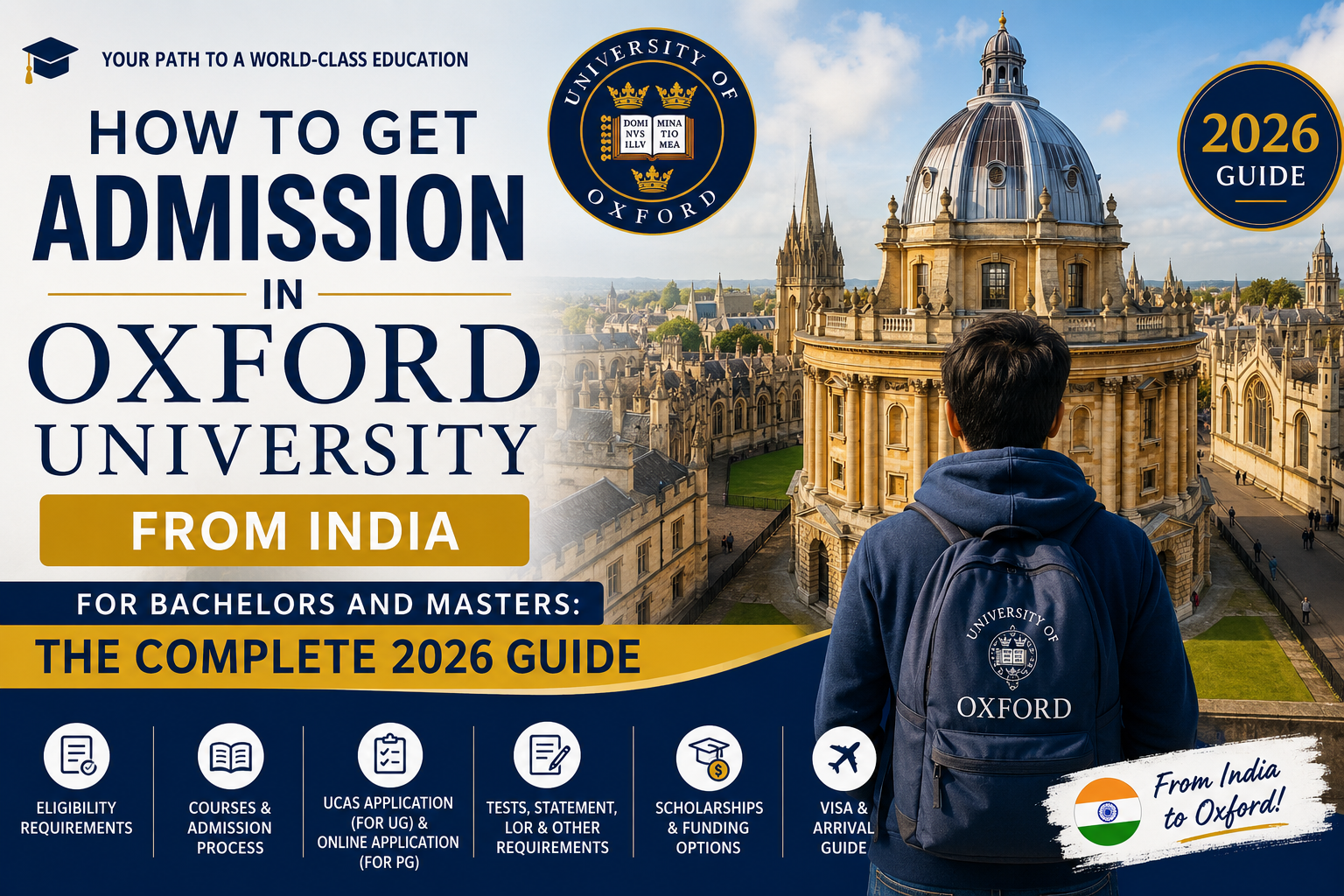
The University of Oxford attracts students from around the world, including applicants from India seeking undergraduate and postgraduate study opportunities.
Admission to Oxford is highly competitive. Applicants need to understand the academic criteria for their chosen course, admissions assessments where applicable, English-language expectations, application timelines, tuition fees and available funding.
This guide explains the key points Indian students should consider when exploring undergraduate or Master’s study at the University of Oxford for 2027 entry.
Why Consider the University of Oxford?
Oxford offers a distinctive academic environment based on intensive subject study, tutorials, lectures, independent learning and academic discussion.
Students become part of both a University department and a college community.
When deciding whether Oxford is suitable for you, consider:
- Course structure and academic content
- Entry criteria for your chosen programme
- Teaching and assessment methods
- College environment
- Tuition and living costs
- Available scholarships and funding
- Your academic interests and long-term goals
Choosing Oxford should be based primarily on academic suitability rather than reputation alone.
Undergraduate Admission for Indian Students
Step 1: Choose the Right Course
Oxford undergraduate applications are course-specific.
Before applying, review the official page for your chosen course and understand:
- Required school qualifications
- Required or recommended subjects
- Admissions-test requirements
- Whether written work is required
- Course structure
- Selection criteria
- English-language expectations
Different Oxford courses can have substantially different entry requirements.
Step 2: Check Indian Academic Eligibility
For Indian applicants, Oxford currently accepts Year XII qualifications completed through CBSE or CISCE (ISC).
State Board examinations and the NIOS Year XII qualification are currently listed as not accepted for meeting Oxford’s standard undergraduate entry qualification.
The required grades depend on whether your chosen Oxford course has an equivalent offer of AAA, AAA or AA*A.
CBSE and CISCE Requirements
| Oxford Course Requirement | CBSE | CISCE / ISC |
|---|---|---|
| A*A*A equivalent | A1, A1, A1, A1, A2, including A1 in relevant subjects | At least 90% overall, with 95%+ in four subjects including relevant subjects, and 85%+ in the fifth |
| A*AA equivalent | A1, A1, A1, A2, A2, including A1 in relevant subjects | 90%+ overall, with 95%+ in three subjects including relevant subjects, and 85%+ in the other two |
| AAA equivalent | A1, A1, A2, A2, A2, including A1 in relevant subjects | 90%+ overall, with 95%+ in two subjects including relevant subjects, and 85%+ in the other three |
These are Oxford’s current India qualification equivalents. Applicants should also check whether their chosen course requires particular subjects.
Academic eligibility alone does not guarantee admission.
Step 3: Check English-Language Expectations
Oxford undergraduate courses currently require a high level of English proficiency.
For students who need to demonstrate English proficiency, Oxford currently lists IELTS Academic at:
- 7.5 overall
- Minimum 7.0 in each component
Other accepted qualifications are also available.
Applicants do not normally need to provide English-language evidence when initially submitting the UCAS application. If an offer is made and evidence is required, Oxford currently requires the condition to be met by the applicable deadline. Oxford University
Always check Oxford’s current English-language page because accepted tests and conditions can change.
Step 4: Choose a College or Make an Open Application
Oxford has a collegiate system.
When completing your undergraduate application, you can generally:
- express a preference for a particular college; or
- make an open application.
College choice does not replace the need to meet the academic criteria for your chosen course.
Applicants should research colleges based on factors such as accommodation, location, facilities and community while keeping course suitability as the main priority.
Step 5: Check Whether Your Course Requires an Admissions Test
Some Oxford undergraduate courses require an admissions test, while others do not.
For 2027 entry, Oxford has introduced UAT-UK assessments for several courses.
These include:
- ESAT for selected science and engineering-related courses
- TMUA for Mathematics and Computer Science-related courses
- TARA for selected social science and related programmes
- UCAT for Medicine
- LNAT for Law
The test required depends entirely on the course.
Oxford’s previous MAT, PAT, TSA and several other Oxford-specific testing arrangements should not be assumed to apply to the 2027 cycle.
For applicants requiring an October UAT-UK test for 2027 entry, Oxford states that the booking deadline was 28 September 2026 at 6pm UK time. Applicants should always check the current test page for their course.
Step 6: Prepare Your UCAS Personal Statement
The UCAS personal statement format has changed.
For 2027 entry, applicants respond to three structured questions rather than submitting one continuous personal statement.
The overall limit remains 4,000 characters, including spaces. UCAS
Students should use their responses to explain:
- Why they want to study the subject
- How their academic studies have prepared them
- What relevant experiences have developed their knowledge or interest
- How they have explored the subject beyond normal classroom learning
For Oxford, academic relevance is particularly important.
Avoid generic statements that do not demonstrate genuine engagement with your chosen subject.
Step 7: Submit Your UCAS Application
For 2027 undergraduate entry, Oxford’s current timeline is:
| Stage | Current 2027 Entry Timeline |
|---|---|
| Begin preparing application | From May 2026 |
| UCAS submission opens | Early September 2026 |
| Oxford UCAS deadline | 15 October 2026, 6pm UK time |
| Written work deadline, where applicable | 10 November 2026 |
| Interviews | Early to mid-December 2026 |
| Decisions | 12 January 2027 |
Oxford’s deadline is earlier than the normal deadline used by many UK universities.
Applicants should not wait until the final day to submit.
Step 8: Check Whether Written Work Is Required
Some Oxford courses require applicants to submit written work.
This does not apply to every programme.
If your course requires written work, follow the current instructions published for that specific course.
For 2027 undergraduate entry, Oxford currently lists 10 November 2026 as the written-work deadline.
Step 9: Prepare for the Oxford Interview
Applicants who are shortlisted may be invited to academic interviews.
Oxford describes these interviews as academic conversations designed to explore how applicants think, respond to ideas and engage with their chosen subject.
For 2027 entry, shortlisted undergraduate interviews are scheduled to take place online in December 2026.
Interview preparation should focus on:
- Explaining your reasoning clearly
- Thinking aloud when appropriate
- Engaging with unfamiliar problems
- Discussing your subject thoughtfully
- Responding constructively to new information
- Demonstrating genuine academic curiosity
The number and format of interviews can vary by course and college.
Step 10: Receive the Admission Decision
Oxford states that undergraduate applicants for 2027 entry will receive their admission decision on 12 January 2027.
Offers may include academic or other conditions that must be satisfied before enrolment.
Even excellent academic results do not guarantee admission because Oxford receives more strong applicants than it can accommodate.
Master’s Admission at Oxford for Indian Students
Graduate admission works differently from undergraduate admission.
Students apply through Oxford’s own graduate application system rather than through the undergraduate UCAS process.
Step 1: Choose the Correct Graduate Programme
Start with the official page of the Master’s programme you are considering.
Review:
- Academic entry criteria
- Programme structure
- Research or taught-course focus
- English-language requirement
- Any course-specific assessment
- Application deadline
- Tuition fee
- Funding opportunities
Oxford does not have one universal Master’s eligibility requirement.
Step 2: Check Academic Eligibility for Indian Qualifications
Oxford provides India-specific equivalencies for graduate applicants.
If a course requires a strong upper second-class UK undergraduate degree, Oxford currently gives examples including:
- A four-year professional bachelor’s degree with around 60% from specified prestigious institutions or 70% from other recognised institutions, or equivalent listed GPA levels
- A three-year bachelor’s degree with around 65% from specified prestigious institutions or 70% from other recognised institutions
If a course requires a first-class UK undergraduate degree, Oxford currently lists higher equivalents, including:
- Four-year professional bachelor’s: around 65% from specified prestigious institutions or 75% from other recognised institutions
- Three-year bachelor’s: around 70% from specified prestigious institutions or 75% from other recognised institutions
Oxford also publishes equivalent GPA scales.
These are equivalency guidelines, not automatic admission thresholds.
The course page remains the primary source because individual programmes can have additional or more competitive expectations.
Step 3: Check English-Language Requirements
Graduate courses specify either Oxford’s Standard or Higher English-language requirement.
Current IELTS Academic benchmarks are:
| Requirement Level | Overall IELTS | Minimum per Component |
|---|---|---|
| Standard | 7.0 | 6.5 |
| Higher | 7.5 | 7.0 |
Other accepted English qualifications are available.
Applicants should check their specific course page to determine which level applies.
Step 4: Check Course-Specific Assessment Requirements
Some graduate programmes may ask applicants to demonstrate additional academic or professional readiness.
Requirements vary significantly between courses.
Do not assume that a particular GRE, GMAT or other score applies to every Oxford Master’s programme.
Check the current course page for the exact programme you are considering.
Step 5: Review Course-Specific Application Requirements
Graduate application requirements vary by programme.
Applicants should review the relevant Oxford course page and application guidance to understand exactly what information or supporting material is required for that course.
Requirements can differ between taught Master’s programmes, research degrees and individual academic departments.
Avoid relying on generic third-party checklists.
Also note that a CV is not universally required for every Oxford graduate course; applicants should provide one only where the relevant course asks for it.
Step 6: Submit the Graduate Application
Graduate applicants submit their application through Oxford’s graduate application system.
Application fees currently depend on course type:
- Taught graduate courses: £75
- Research courses: £20
Oxford also offers application-fee waiver arrangements in certain circumstances.
Step 7: Check the Course Deadline
Graduate deadlines are course-specific.
Many programmes use deadlines in December or January, particularly where applicants wish to be considered for Oxford funding.
Students should check the exact deadline shown on their chosen course page rather than relying on a general university-wide deadline.
Applications submitted by the relevant December or January course deadline are also important for consideration for many Oxford scholarships.
Oxford Tuition Fees for International Students
Undergraduate Course Fees
For students classified as Overseas for 2027–28, Oxford currently lists undergraduate annual course fees generally ranging from:
£39,620 to £66,580 per year
Clinical Medicine has significantly higher fees in the clinical years.
The exact amount depends on the programme.
Students should always check the fee listed on the page for their chosen course before making a financial decision.
Graduate Course Fees
Graduate tuition fees vary substantially by department, programme and course duration.
Rather than relying on a broad fee range, applicants should check the current course fee published on the individual Oxford graduate course page.
Fees can also increase between academic years.
Living Costs in Oxford
Tuition is only one part of the cost of studying at Oxford.
Students should also budget for:
- Accommodation
- Food
- Personal expenses
- Study-related expenses
- Transportation
- Social activities
- Other day-to-day costs
Oxford currently estimates living costs for a single full-time student in 2027–28 at approximately:
£1,475 to £2,175 per month
Actual spending varies according to accommodation choices and lifestyle.
Students should include living expenses when comparing the total affordability of studying at Oxford.
Scholarships and Funding
Oxford offers a range of full and partial graduate scholarships.
For the 2027–28 academic year, the University expects to offer more than 1,200 full or partial graduate scholarships to new students.
Scholarships vary according to:
- Academic merit
- Course
- Nationality or residence
- Subject area
- Financial circumstances
- Other eligibility conditions
For many Oxford scholarships, including Clarendon, applicants do not submit a separate scholarship application.
Instead, applicants who submit their graduate application by the relevant December or January course deadline are considered where eligible.
Some scholarships have different application arrangements, so students should check each scholarship’s current criteria carefully.
Oxford Application Timeline for Indian Students
Undergraduate — 2027 Entry
| Stage | Timing |
|---|---|
| Research courses and colleges | As early as possible |
| Start UCAS preparation | From May 2026 |
| Application submission available | Early September 2026 |
| Oxford UCAS deadline | 15 October 2026, 6pm UK time |
| Written work, if required | 10 November 2026 |
| Interviews | Early to mid-December 2026 |
| Decisions | 12 January 2027 |
Graduate — 2027–28 Entry
Graduate timelines differ by course.
Applicants should:
- identify the correct course;
- check its opening date;
- confirm the exact application deadline;
- check whether an earlier deadline applies for funding consideration; and
- allow sufficient time to complete the application accurately.
Many funding-linked graduate deadlines fall in December or January.
Frequently Asked Questions
Can Indian students apply to Oxford after Class 12?
Yes, provided they hold or are expected to achieve an accepted qualification and meet the entry requirements of their chosen course.
Oxford currently accepts qualifying CBSE and CISCE Year XII credentials for undergraduate admission.
Does Oxford accept Indian State Board Class 12 qualifications?
Oxford’s current international-qualification guidance lists Indian State Board examinations and NIOS Year XII as not accepted for meeting its standard undergraduate qualification requirement.
Students with another accepted international qualification may have a different route and should check Oxford’s current guidance.
What percentage is required for Oxford from India?
There is no single percentage applicable to every applicant.
For undergraduate study, requirements vary according to the course’s equivalent Oxford offer and whether the student is applying with CBSE or CISCE qualifications.
For graduate study, Oxford’s Indian-equivalency guidance varies according to whether the course requires the equivalent of a strong upper second-class or first-class UK degree.
Does Oxford require IELTS for Indian students?
Some applicants may need to demonstrate English-language proficiency.
For undergraduate study, Oxford currently uses a high-level English requirement equivalent to IELTS Academic 7.5 overall with at least 7.0 in each component, unless an applicable exemption is available.
For graduate study, the course page specifies either Standard or Higher English proficiency.
Does every Oxford undergraduate course require an admissions test?
No.
Some courses require an admissions test and others do not.
For 2027 entry, Oxford uses ESAT, TARA and TMUA for selected programmes, alongside UCAT for Medicine and LNAT for Law.
Is admission to Oxford guaranteed if I meet the minimum requirements?
No.
Meeting the academic criteria makes you eligible to be considered but does not guarantee an offer.
Oxford assesses applicants competitively according to the selection process for each course.
Do all Oxford Master’s programmes require the same academic grades?
No.
Academic criteria vary by course.
Applicants should check the exact graduate entry criteria published for the programme they wish to study.
How much does Oxford cost for an international student?
For undergraduate Overseas students starting in 2027–28, Oxford currently lists annual course fees generally between £39,620 and £66,580, with Clinical Medicine potentially higher.
Oxford separately estimates living expenses at around £1,475–£2,175 per month.
Graduate fees vary by programme.
Final Thoughts
Applying to the University of Oxford from India requires strong academic preparation, careful course selection and close attention to the current admissions process.
There is no single formula that guarantees admission.
Students should focus on:
- Choosing a course that genuinely matches their academic interests
- Confirming that their qualification is accepted
- Meeting course-specific academic criteria
- Preparing appropriately for any required admissions assessment
- Building strong subject knowledge
- Following Oxford’s published application timeline
- Planning realistically for tuition and living costs
- Researching available scholarships and funding
Because Oxford updates admissions information between application cycles, applicants should verify important dates, criteria, fees and assessment arrangements directly through the University of Oxford before submitting an application.
Planning Your Oxford Study Journey?
Wizdom International provides independent international-education counselling for students exploring universities in the UK and other study destinations.
Our guidance may include:
- University and course comparison
- Academic profile discussion
- Programme shortlisting
- Study planning
- Admissions timeline guidance
- English-language test preparation
- General education counselling
Speak with our counsellors to discuss your academic goals and explore suitable study options.
Important Note
Wizdom International is an independent private consultancy and is not affiliated with the University of Oxford.
Admission decisions are made independently by the University of Oxford.
Applicants should verify current academic criteria, deadlines, fees and programme information directly through official University sources before making an application or financial decision.