
Introduction
For years, the IELTS exam has been seen as a mandatory gateway for Indian students dreaming of a UK education. The test costs between ₹19,000 and ₹25,000, requires two to three months of dedicated preparation, and produces a score with an expiry date. But here is the reality in 2026 — you can study in the UK without IELTS, and thousands of Indian students are already doing it.
This comprehensive guide breaks down everything you need to know: which universities accept students without IELTS, what alternatives exist, how the visa process works, and a step-by-step application plan.
Can Indian Students Study in the UK Without IELTS?
The short answer is yes.
Studying in the UK without IELTS does not mean avoiding English language requirements. It means meeting those requirements through alternative, university-approved methods rather than a single standardised test. UK universities are permitted to assess English proficiency in multiple ways, and many institutions recognise that students who have studied for years in English-medium schools or universities already use English at an academic level.
For 2026 entry, a degree-level UK Student visa still requires English equivalent to CEFR level B2 (upper-intermediate level). However, you can reach this level without sitting IELTS if your university agrees to judge your English another way.
Key Takeaway: “Without IELTS” means skipping that specific test — not skipping English evidence.
Why UK Universities Offer IELTS Waivers
UK universities offer IELTS waivers for several compelling reasons:
-
Academic Readiness Over Test Performance — Universities are primarily concerned with whether you can understand lectures, write assignments, participate in discussions, and complete assessments successfully. Years of classroom learning in English often matter more than a 2–3 hour exam score.
-
Attracting International Talent — Offering IELTS waivers helps UK universities attract diverse international talent without compromising academic standards.
-
Digital Test Reliability — Tests like the Duolingo English Test use advanced AI to track proficiency securely and accurately.
-
Recognition of English-Medium Education — If you have spent years getting a degree where every lecture was in English, many universities question why you should take another test to prove what is already evident.
5 Pathways to Study in the UK Without IELTS
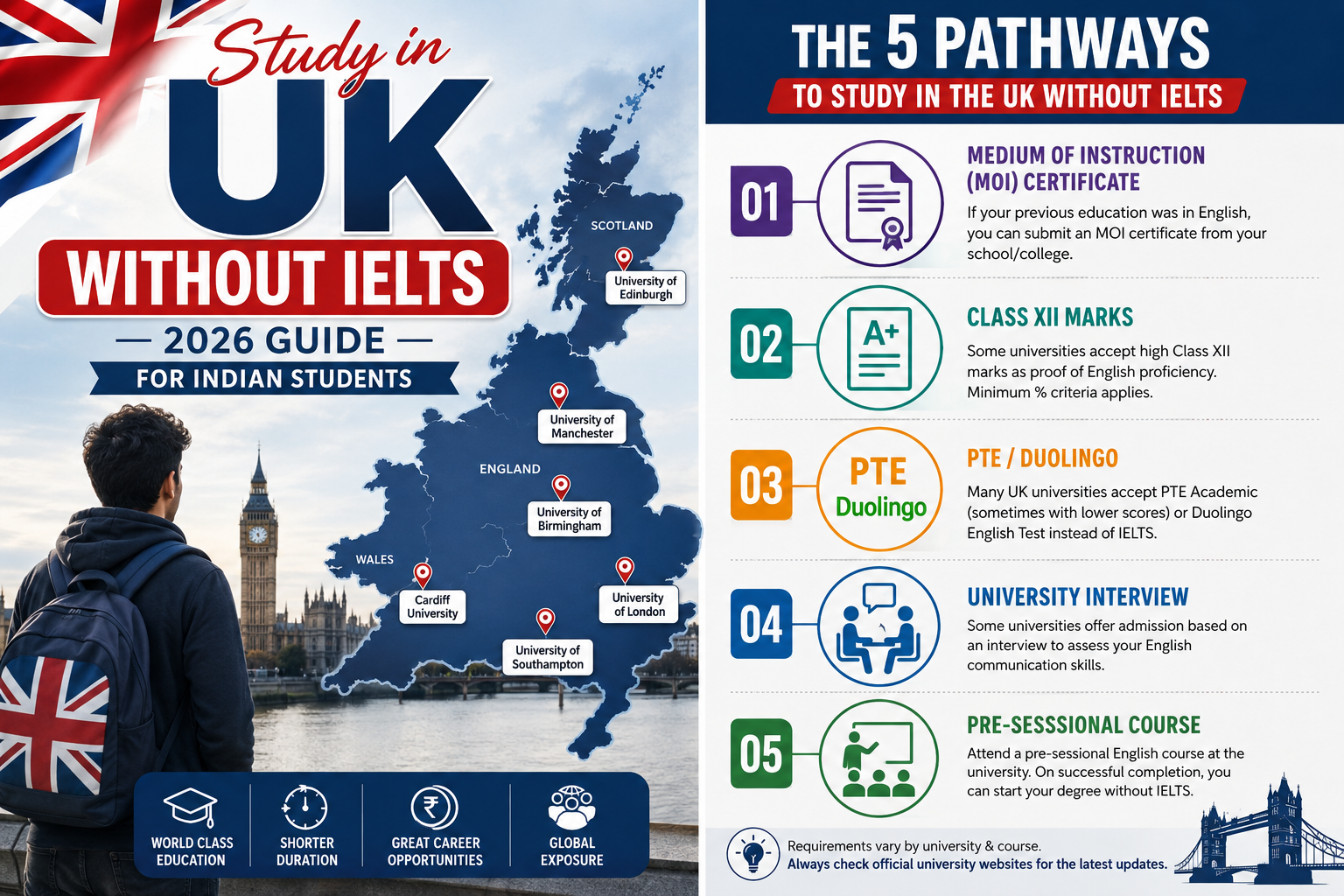
There are five common routes to study in the UK without IELTS:
1. Medium of Instruction (MOI) Certificate
An MOI certificate is an official document from your Indian school, college, or university confirming that your education was conducted entirely in English. For 2026-27 admissions, a growing number of UK universities accept the MOI certificate as a valid alternative to IELTS, TOEFL, or PTE.
What an MOI Certificate Must Include:
-
Your full name as registered at the institution
-
The program of study and years of enrolment
-
An explicit declaration that English was the complete medium of instruction
-
Name, signature, and official stamp of the issuing authority (Registrar, Controller of Examinations, Principal, or Head of Department)
Important: The document costs nothing to obtain and most Indian universities process it within a few days to two weeks. However, the language must be formal and unambiguous — a certificate saying “English is used in some subjects” will not satisfy most universities.
💡 Pro Tip: Most universities want your MOI degree to have been completed within the last 2 to 5 years.
2. Class XII English Marks
Students who scored well in English in their Class 12 board exams may be exempt from IELTS. Requirements vary by university:
| University | Class XII English Requirement |
|---|---|
| University of Bristol | CBSE/CISCE English at 70-80% |
| University of Leicester | 70% in English (State Boards, CBSE, ICSE) |
| University of Gloucestershire | 70%+ in English (CISCE, CBSE, Maharashtra, Tamil Nadu, Telangana, Karnataka, Andhra Pradesh, Kerala, West Bengal) |
| University of Wolverhampton | 72% in Year 12 English |
| GCU Glasgow | 70%+ in English (CBSE and CISCE only) |
3. Alternative English Proficiency Tests
Many UK universities accept these alternatives to IELTS:
-
PTE Academic — Accepted by almost all UK universities including all Russell Group universities. Score equivalencies: PTE 58 ≈ IELTS 6.5; PTE 65 ≈ IELTS 7.0
-
Duolingo English Test — Accepted by over 70 leading UK universities for 2026 admissions. Score requirements typically range from 100 to 130
-
TOEFL iBT — Widely accepted, though note that UKVI no longer lists TOEFL iBT for direct Student Route visa applications
4. University-Conducted English Tests or Interviews
Several UK universities offer their own online English proficiency tests or conduct video interviews to assess language skills. These are usually free and scheduled after you submit your application.
5. Pre-sessional English Courses
If you don’t meet the English requirement, you can opt for a pre-sessional English course (6–12 weeks) offered by the university to improve your language skills before starting your main course.
UK Universities Accepting Students Without IELTS (2026)
Over 30 UK universities accept MOI evidence from Indian applicants for 2026 entry, ranging from post-1992 universities to Russell Group members on a programme-by-programme basis.
Russell Group Universities with Flexibility
| University | Alternative Accepted |
|---|---|
| University of Bristol | CBSE/CISCE English 70-80% |
| University of Warwick | Alternative pathways available |
| University of Exeter | ICSE/CBSE, West Bengal, Maharashtra boards accepted |
Other Prominent Universities
| University | Alternative Accepted |
|---|---|
| University of Leicester | 70% in Class XII English or graduates from top Indian universities |
| University of Portsmouth | MOI, Class XII English |
| Coventry University | MOI for select programs |
| University of Hertfordshire | MOI letter + conditional admission |
| University of Bedfordshire | MOI from English-medium institution |
| University of West London | MOI accepted |
| Teesside University | MOI accepted |
| Northumbria University | Alternative pathways available |
| Swansea University | Alternative pathways available |
| Aston University | Alternative pathways available |
| University of Greenwich | Class XII English scores |
| De Montfort University | Class XII English scores, MOI |
| University of South Wales | MOI accepted |
| University of East London | MOI for most programs |
| Anglia Ruskin University | MOI + English pathway |
University of Leicester — Special Mention
The University of Leicester has announced significant updates for Indian applicants for 2026, including:
-
IELTS waiver with 70% in English in Class XII from State Boards, CBSE, or ICSE
-
No English test required for graduates of Anna University, Mumbai University, Pune University, Bangalore University, University of Delhi, University of Madras, IIMs, and IITs
-
Study gaps no longer pose a barrier for IELTS waivers
The Critical Distinction: University Admission vs UK Visa
This is where many students get confused. There is a critical distinction between university admission requirements and UK visa requirements:
| University Admission | UK Student Visa | |
|---|---|---|
| IELTS required? | Often not — many accept MOI, PTE, Duolingo | MUST be a SELT (Secure English Language Test) |
| Acceptable tests | IELTS, PTE, TOEFL, Duolingo, MOI letter | IELTS UKVI, PTE Academic UKVI, Trinity SELT, LanguageCert |
| Can you use regular IELTS? | Yes, for admission | NO — must be IELTS UKVI (Academic for UKVI) |
⚠️ Important: Even if a UK university admits you without IELTS (using an MOI letter), you may still need an IELTS UKVI or PTE Academic UKVI score to obtain the UK Student Visa.
However, there is an exemption: A UK student visa without IELTS is completely allowed when the university confirms your English ability. The UK visa decision is based on your Confirmation of Acceptance for Studies (CAS).
How It Works for Your Visa:
-
You submit your MOI certificate to the admissions team
-
The admissions team reviews it and, if accepted, issues your CAS letter noting that English proficiency was verified through MOI
-
You submit your visa application with the CAS letter
-
The visa officer reads the CAS letter and processes your application without requesting a test score
⚠️ Critical Check: Your CAS letter must explicitly state that your English proficiency was assessed using your MOI certificate. If that line is absent, a visa officer may reject the application.
Eligibility Criteria for IELTS Waivers
Indian students are among the most common recipients of IELTS waivers. Eligibility depends on:
-
Where and how you studied previously — Students from CBSE, ICSE, ISC, and recognised state boards are often eligible if they have scored well in English in Class 12
-
Level of course — Undergraduate and postgraduate applications have more flexibility. Foundation or diploma courses have stricter rules — you will almost always need a SELT
-
University-specific requirements — Minimum English scores vary by institution and course
Who Qualifies for UKVI IELTS Exemption?
According to UK Immigration Rules:
-
✅ You received a degree equivalent to a UK bachelor’s or higher, taught in English
-
✅ You received a GCSE, A-Level, or a previously acquired UK degree
-
✅ Your university issued an official MOI letter confirming your course was taught in English
-
❌ India does not qualify under the “national of an English-speaking country” category
Step-by-Step Application Process
Step 1: Research and Shortlist Universities
Start by researching UK universities that waive IELTS. Look for universities that accept MOI certificates, Class XII English scores, or alternative tests.
Step 2: Check Specific Requirements
Each university has different criteria. Check:
-
The minimum English score required in Class XII
-
Whether MOI is accepted for your specific program
-
Alternative test score requirements (PTE, Duolingo, etc.)
Step 3: Prepare Necessary Documents
Documents required for admission without IELTS:
-
Valid passport
-
Class 10 and Class 12 marksheets
-
Bachelor’s degree transcripts and certificate (for PG applicants)
-
Medium of Instruction (MOI) certificate — from your institution’s Registrar or examination office
-
Statement of Purpose (SOP)
-
Updated CV/Resume
-
Letters of Recommendation (usually 2 for PG courses)
-
Work experience letter (if applicable)
-
Proof of funds
Step 4: Submit Your Application
Apply through UCAS (for undergraduate) or directly to the university (for postgraduate). Submit your MOI certificate or alternative English proof along with your application.
Step 5: Receive and Review Your CAS Letter
Once accepted, review your CAS letter carefully. Confirm it explicitly states your English proficiency was assessed using your MOI certificate or alternative proof. If this line is missing, contact your university immediately.
Step 6: Apply for Your Student Visa
Submit your visa application with:
-
Your CAS letter
-
Financial proof (28 days maintenance)
-
Passport and photographs
-
Tuberculosis test results (from an approved UKVI clinic in India)
UK Student Visa Requirements for 2026
Financial Requirements
You must show funds for 9 months:
-
London: £1,483/month = £13,348 total
-
Outside London: £1,136/month = £10,224 total
Funds must be held in your bank account for at least 28 consecutive days before applying.
Visa Costs
-
Student visa application fee: £558 (approximately ₹72,400)
-
Immigration Health Surcharge: £776/year (approximately ₹1,00,600)
2026 Visa Updates
-
E-Visa System: From July 15, 2025, UK student visas are issued as digital e-visas linked to your passport
-
Graduate Route: Post-study work visa offers 18 months stay after completing your degree (PhD students get 3 years)
-
Dependent Restrictions: Only students enrolled in PhD or research-based master’s programs can bring dependents
Common Mistakes to Avoid
-
Confusing University Admission Rules with Visa Rules — A university can issue your CAS without an IELTS score, but the visa officer will check your English evidence against Immigration rules
-
Submitting a Weak MOI Certificate — The certificate must confirm English as the full medium of instruction, not just a partial one
-
Missing the CAS Line — If your CAS doesn’t explicitly state how your English was assessed, visa rejection is likely
-
Assuming All Programs Qualify — Some programs (like Nursing) have stricter requirements. A general university MOI waiver does not on its own satisfy NMC registration for nursing
-
Outdated MOI — Most universities want your MOI degree to have been completed within the last 2 to 5 years
Frequently Asked Questions
Is IELTS mandatory for a UK student visa?
No, but you must prove English proficiency at CEFR B2 level. This can be done through alternative evidence if you qualify.
Can I get a conditional offer without IELTS?
Yes — you can get a conditional offer from many UK universities without IELTS. The offer holds your seat while you fulfill the English proficiency condition later via MOI or other alternatives.
Which Indian boards are accepted for IELTS waivers?
CBSE, ICSE, ISC, and recognised state boards are widely accepted. Some universities only accept CBSE and CISCE.
What is the minimum Class XII English score required?
Typically 60-75% in English, depending on the university and course. Top universities may require 70% or higher.
Can I use Duolingo for my UK visa?
No — Duolingo is accepted by universities for admission but is NOT accepted for UK student visa applications, which require a SELT-approved test.
Final Thoughts
Studying in the UK without IELTS is not a loophole or an exception — it is a recognised admission pathway used by thousands of international students every year. For Indian students who have completed their education in English-medium institutions, the MOI certificate pathway offers a cost-effective and time-saving alternative to traditional language testing.
The key is understanding the distinction between university admission requirements and visa requirements, ensuring your CAS letter correctly documents your English proficiency assessment, and carefully following each step of the application process.
With over 30 UK universities now accepting MOI certificates and alternative English proofs for 2026 admissions, the dream of a UK education is more accessible than ever for Indian students — without the IELTS hurdle.